


The New York State Assembly just passed a bill that will ban potassium bromate, a key ingredient found in the most commonly used pizza flour in New York City. Once signed into law, producers and distributors will have one year to empty their stock before its manufacture and sale become illegal. Restaurants and other end users will then be able to use what they have until its expiration date as long as its within three years (although most flour expires one year from its milling date). This marks a crucial moment in New York pizza history. You can read the full text of the New York Food Safety and Chemical Disclosure Act below.
*READ NEW YORK STATE ASSEMBLY BILL 1556 HERE*
*READ NEW YORK STATE SENATE BILL 1239 HERE*
About the Potassium Bromate Ban
The ingredient being banned by this legislation is called Potassium Bromate. It’s a dough conditioner, which means it shortens mix time and oxidizes mixed dough through the fermentation stage. Recent years have seen a major backlash against potassium bromate and other non-essential additives such as enrichments, bleaching chemicals, and anti-caking agents. The need for these ingredients has disappeared as more advanced bread techniques have replaced them. Dough conditioners like potassium bromate are unnecessary for bakers and pizza makers who use preferments, flour that contains ascorbic acid, long bulk fermentation, or have more space for longer fermentation periods.
Even if these techniques weren’t in use, it would still be wise to ban ingredients like potassium bromate because its a known carcinogen. It’s already banned in the European Union, Canada, Argentina, Brazil, Nigeria, South Korea, and Peru. The United Kingdom banned it in 1990. Prior to this legislation, bromate has remained unrestricted in most of the United States with the exception of California, which required strict labeling on products that used it until the state fully banned it in October 2023. These bans are all based on research that began in the 1980s, revealing its link to cancer in lab rats. Tests have found potassium bromate to be potentially carcinogenic in large quantities. Fully cooking bromated flour seems to at least partially negate the risk, but there’s still enough evidence in favor of its expulsion.
It’s worth stating clearly that this ingredient has nothing to do with weight loss, gluten intolerance, or diabetes. It’s a cancer risk. The only reason it has been allowed in food products is that it was already in use by 1958, when the USFDA adopted the GRAS standard (Generally Recognized As Safe). The concept was to minimize labeling requirements for common ingredients like salt, sugar, vinegar, etc. Potassium bromate was grandfathered in because of its use prior to 1958. This new legislation helps close the loophole left by the lax guidelines imposed by GRAS standards.
How All Trumps Became NYC’s Favorite Flour
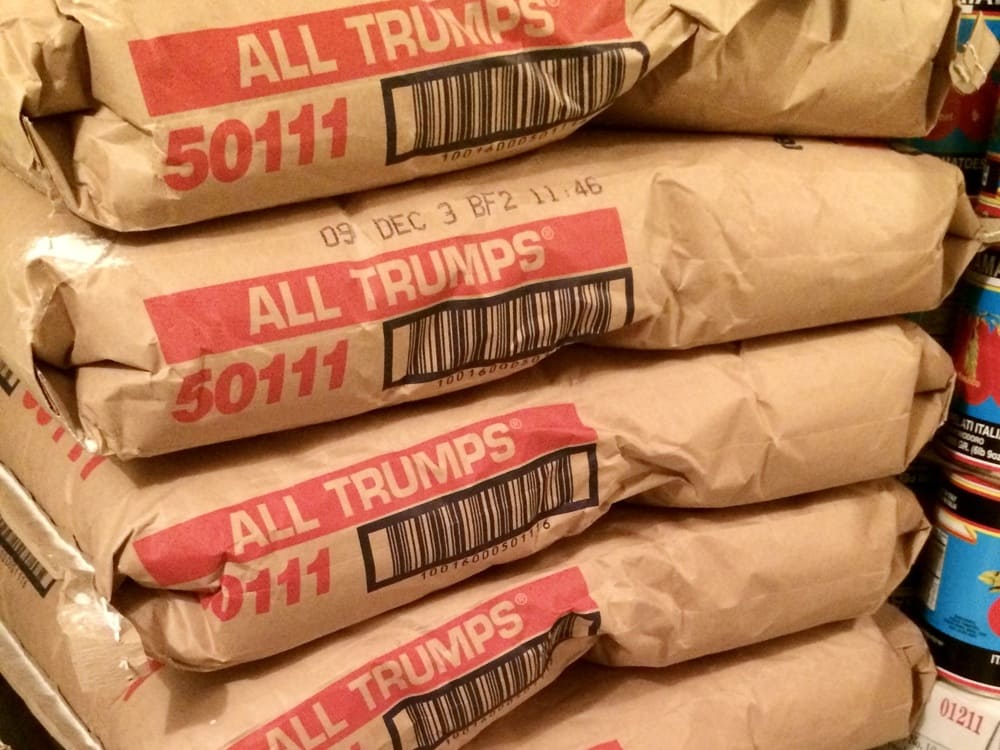
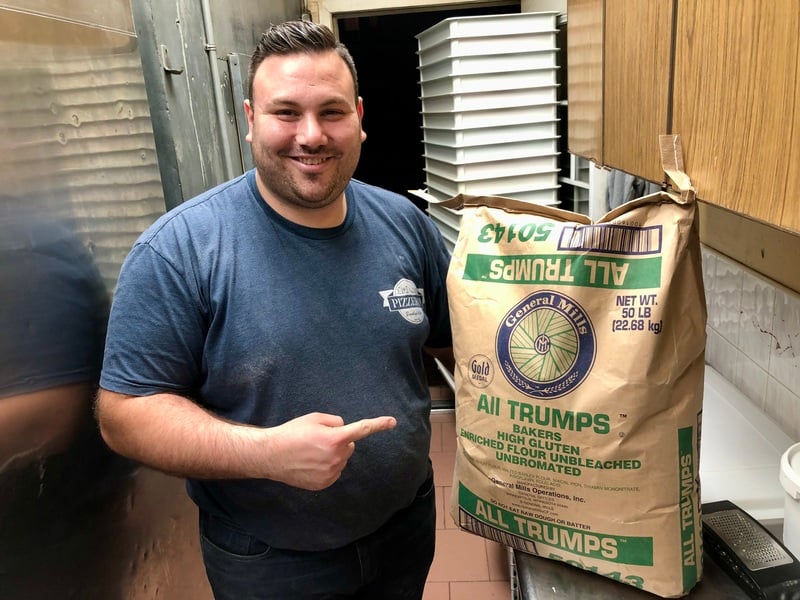
For better or for worse, bromated flour has become the backbone of New York pizza. I’m talking here specifically about General Mills All Trumps flour. Pop into any of the 2,300 pizzerias in New York City and it’s likely you’ll find a stack of All Trumps. It’s hard to nail down exactly how All Trumps became the preferred flour of NYC pizzerias, but it probably has to do with its birth in the Buffalo, NY mill (check out the first photo in this article and you’ll see the Buffalo mill code “BR” in the printed code). It’s also significant that a bromated flour like All Trumps would have appealed to tiny NYC slice shops because its ability to be used after a short maturation period made it quite attractive.
Being aware of All Trumps’s ubiquity in NYC, I’ve been on somewhat of a quest to learn as much as possible about its history. I’ve read books about the history of General Mills (one published back in 1951), inspected an archive of a General Mills corporate newsletter called The Modern Millwheel at the New York Public Library, and communicated directly with the archivists at General Mills. I even bought a 1946 All Trumps flour sack off Ebay!
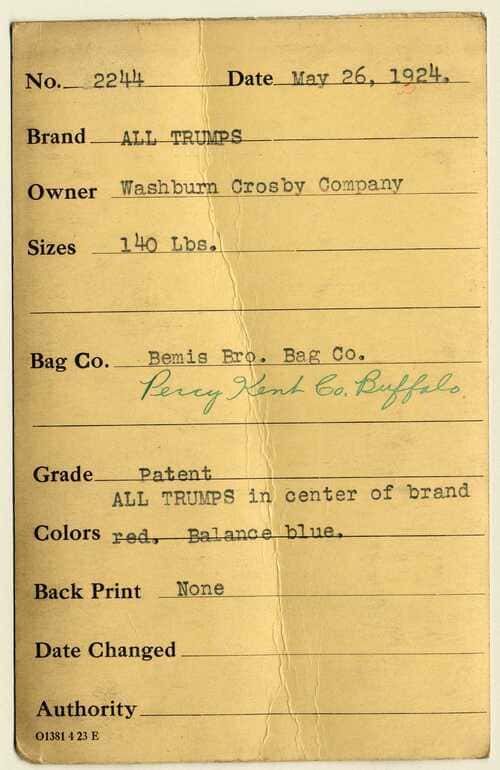
The earliest reference I’ve seen to All Trumps is a 1924 flour sack order from the Washburn Crosby Company (which became part of General Mills in 1928). It’s an order for 140 lb bags from the Bemis Bro. Bag Co. and Percy Kent Co. Buffalo. General Mills was able to find a series of internal memos discussing the need to change the wording on the All Trumps bag from “High Protein” to “High Gluten.” Flour nerds know there’s no gluten in flour, just the necessary protein to form gluten. So making this change was done purely for marketing purposes.
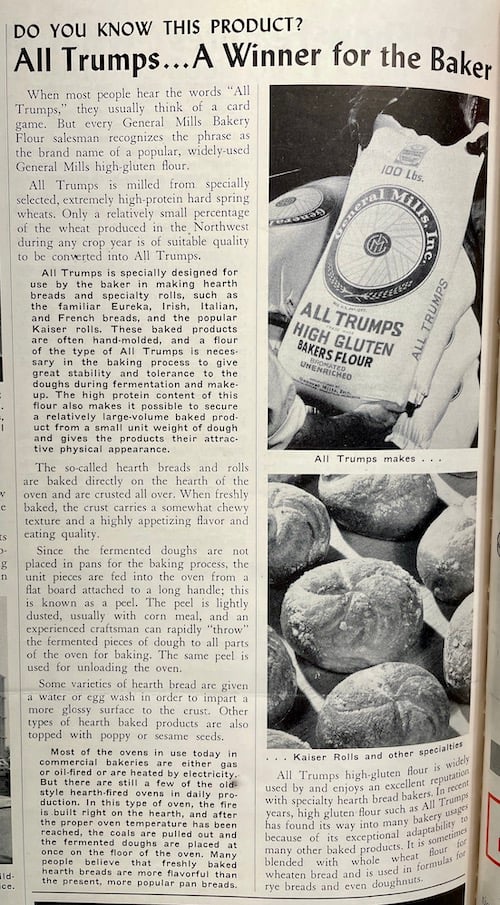
The next major reference I found for All Trumps is a 1953 article about the product in The Modern Millwheel. It boasts about the product’s ability to produce high volume loaves, particularly for hearth-baked breads. In the article, All Trumps is described as being a “popular, widely used General Mills high-gluten flour.” Its name is a mystery, although the article’s reference to it being a powerful hand of cards could be the source.
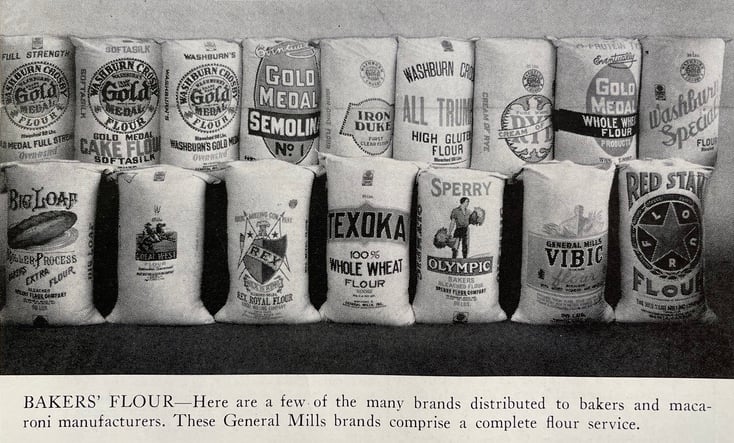
All Trumps may be the most common flour in NYC pizzerias, but that’s not to say it’s the only bromated flour. General Mills sells several bromated flour products, including Gold Medal Bakers Flour, Remarkable, Full Strength, Superlative, and All Aces. They also sell several bromated products under the Pillsbury brand, including Best Bakers Patent Flour, So Strong, Balancer, and XXXX Patent. Some of these product names have options for both bromated and unbromated versions, so you’ll want to check your flour company’s website (here’s General Mills, which also owns Pillsbury) to determine whether your product contains bromate. You can also just look on the bag and you’ll see an ingredient list.
History of Potassium Bromate
The baking industry developed potassium bromate in the early 1900s and received a patent for use in baking in 1915. It’s been used in commercial baking since 1923, which is right around the time a product called All Trumps was introduced by the Washburn-Crosby company. All Trumps was marketed to bakeries looking for stability, tolerance, and large volume in hearth-baked breads. All Trumps is a high protein flour (currently 14.2%) so it’s extremely strong and resilient.
To say All Trumps became popular is an understatement. It’s ubiquitous. Nearly every pizzeria in NYC, particularly the slice shops, use it religiously. Walk in front of any pizzeria on delivery days and you’re likely to see a stack of bags emblazoned with the “General Mills All Trumps Gold Medal 50111” identifiers. When people credit NYC’s great pizza to the city’s tap water, I like to remind them that this particular flour product (despite its clear flaws) easily has more impact. That’s not to say it’s critical to New York style pizza. It most certainly is not!
Life After Bromate
As mildly obsessed as I may be with All Trumps flour, I’m positive that the disappearance of potassium bromate will not result in a decline in NYC’s pizza quality. In fact, I think it will cause just the opposite. First we need to admit that many of the most talked-about pizzerias in town don’t use bromated flour. Just about all the Neapolitan pizzerias use imported flour, which contains nothing but wheat. The newer hyped pizzerias like L’industrie, Lucia, Upside, Fermento, Brooklyn DOP, Chrissy’s, and Ceres all built their doughs around avoiding potassium bromate. As I always say on our NYC pizza tours, the proof is in the pizza. These places make pizza with incredible texture and fermentation flavor.
Losing potassium bromate will not ruin New York pizza, I think it will actually make our pizza BETTER! At first we’ll have a bit of shock from the change. Old school pizzerias won’t know what to do and many will bury their heads in the sand as the run way to use their existing stockpile winds down. Those pizzerias will make worse pizza than they’re making today (I’m commenting only on the bite, completely ignoring the carcinogenic aspect). Or they’ll find a replacement flour and make something close enough that their customers won’t detect any negative changes. Once the legislation shakes things out, the surviving pizzerias will have discovered ways to make their pizza without potassium bromate (see next section for a list of suggestions). It’s going to mean learning more about the fermentation process, which will be frustrating in the short term but invigorating in the long run. If the pizza scene in NYC is great today, it’s going to be even better in 5 years!
Adjusting Your Dough Recipe
The new legislation is going to create some industry shock, but smart operators will start experimenting right now to get ready for it. Old school operators won’t want to admit it, but the many books about bread baking and pizza making that have come out in the past 10 years will save them. There are tons of young operators who would be honored to consult for legacy pizzerias to help them update their dough. In the meantime, here are a few ways pizzerias can adapt their existing dough recipes to a post-bromate world.
- General Mills sells an un-bromated version of All Trumps! It’s just as strong but lacks the carcinogens.
- Tons of flour companies offer strong flour that’s not bromated. No flour products from King Arthur Baking are bleached or bromated. Start with Sir Lancelot, that’s the closest comparison in terms of protein percentage. Caputo is an Italian company that developed an All Trumps competitor a few years back (I worked on that project!) called Caputo Americana that’s very good as well. While I’m at it, the Tony Gemignani flour from Central Milling is an incredible replacement for All Trumps.
- One good replacement for potassium bromate is ascorbic acid (vitamin C). It acts as an oxidizer, which is exactly what potassium bromate was doing. Several flour products already use ascorbic acid as a dough conditioner.
- Some brands of instant dry yeast (not active dry) contain ascorbic acid, so it might be worth looking into that.
- A longer mix time could develop enough strength to compensate for the loss of bromate. The only problem is a longer mix will heat up your dough, which will result in blown dough. You can offset this by decreasing your water temperature and by adding that cold water slowly to keep the temperature under control.
- Diastatic malt will get your some increased enzymatic activity. Start by trying this at 1% of your flour weight.
- Preferments like poolish and biga act as dough conditioners! If you’re unfamiliar with these terms, they’re both preferments. Poolish is equal parts water and flour, biga has less water than flour. Both contain commercial yeast. You make these by removing a portion of the ingredients from your final dough quantities and mix them together the day before you intend to use them. The next day, just add them to the remaining ingredients from your recipe and you’ll be set. So much more to say about these so please reach out if you have any questions.
When Does This Actually Become Law?
We don’t know. Once this signed bill gets delivered to the governor, she’ll have 10 days to veto it before it becomes law. According to SPT guide Dan Kaminsky, who has some expertise in this, “It is quite common for leaders to delay delivering a bill to the governor (either political reasons, or wanting to ensure she supports it, etc.). Especially now that it is end of session (very hectic time), bills often are delayed. If they don’t deliver the bill to her by the end of the legislative session (first or second week of June [ED: It’s currently scheduled to end June 4] the clock becomes 30 days once delivered. In this case delivery usually happens by December to ensure the bill gets signed before having to re-go through the process again in the new legislative session.”
So the short answer here is we really don’t know. There’s always a chance it will get vetoed, but my personal gut reaction is that it won’t. Keep in mind, I’m not at all educated about the greater context of the bill. Anecdotally, I can see this bromate ban being embraced by pizza makers more than it’s being rejected. Even if it doesn’t go through for whatever reason, it’s already forcing restaurants to reconsider their product purchases.
